Skip to content



CHINT ELECTRIC
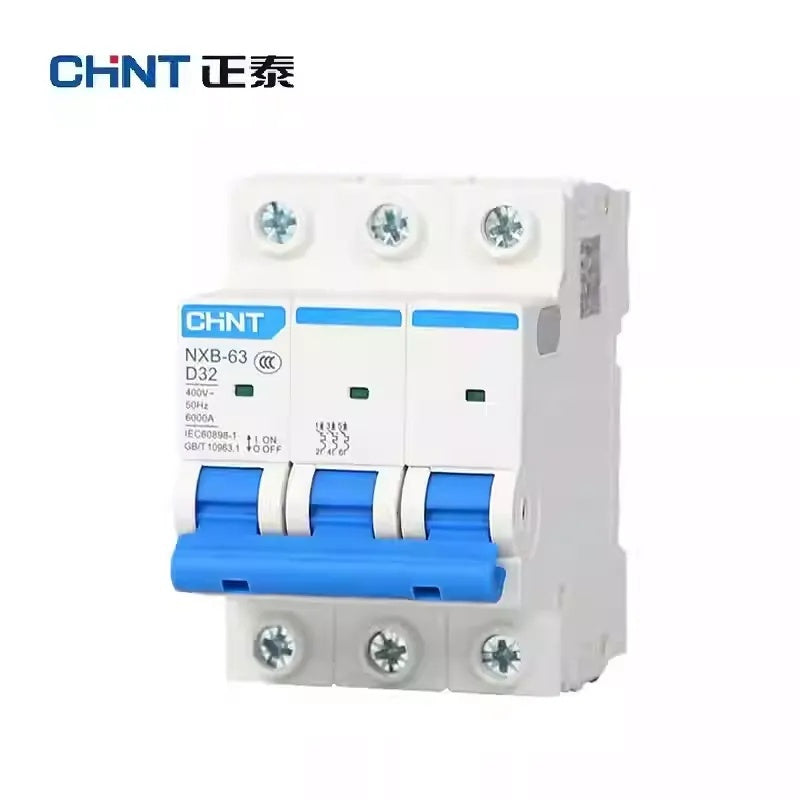
CHINT NXB-63 D-Type MCB 6A-125A 1P 2P 3P 4P Motor-Specific Power Circuit Breaker
Regular price
$12.50 USD
Regular price
Sale price
$12.50 USD
Unit price
per
Shipping calculated at checkout.
Couldn't load pickup availability
CHINT NXB-63 D-Type MCB
6A-125A 1P 2P 3P 4P
Motor-Protection Power Circuit Breaker
Technical Specifications
-
Brand: CHINT
-
Model: NXB-63 D-Type
-
Curve Characteristic: D-Type (10~20In tripping current)
-
Rated Current: 6A~125A
-
Pole Options: 1P, 2P, 3P, 4P
-
Rated Voltage: AC 230V/400V
-
Frequency: 50/60Hz
-
Installation: 35mm Standard DIN Rail
-
Protection Functions: Overcurrent Protection, Short-Circuit Protection
-
Shell Material: Flame-Retardant Insulating Material
Typical Applications
-
Small Motors (6A~25A): Household water pumps, exhaust fans, range hoods, small workshop fans (0.1kW~3kW).
-
Medium Motors (32A~63A): Water pumps, air compressors, fans, mixers (3kW~30kW), central air conditioning compressors, small production line motors.
-
Large Motors (80A~125A): Large air compressors, water pumps, crushers, mixers (30kW~75kW), large-scale conveyor systems, industrial furnaces.
-
Other Scenarios: Industrial power distribution cabinets, commercial electrical systems, auxiliary power protection for motor control circuits.
Selection Tips & Notes
-
Distinguish D-Type & C-Type MCBs: C-type (5~10In tripping) for lighting/household loads; D-type (10~20In tripping) for motors/power loads?€?misuse causes tripping or protection failure.
-
Current Matching: Select MCB rated current 1.2~2.5 times the motor?€?s rated current (reserve 20%~100% margin) to withstand startup current impact.
-
Pole Selection: 1P/2P for single-phase motors; 3P/4P for three-phase motors (4P recommended for neutral wire protection).
-
Special Note: For AC loads only; do not use for DC circuits (select dedicated DC circuit breakers). Suitable for industrial, commercial, and motor control scenarios.
Troubleshooting of Common Faults
If a fault occurs, it is recommended to consult an electrician. Do not operate the device by yourself.
| Fault Phenomenon | Cause Analysis | Troubleshooting Method |
|---|---|---|
| Cannot Close | Short circuit or leakage at the load end | Check the load status |
| Malfunction of the operating mechanism | Replace the product | |
| Mismatch between the circuit breaker's rated current and the load current | Replace with a product of appropriate specification | |
| Check if the residual current accessory has been reset | Press the reset button | |
| High Temperature | Loose terminal screws or uncompressed wires | Tighten the terminal screws |
| Selected wire cross-sectional area is too small | Replace with a wire of appropriate specification | |
| Mismatch between the circuit breaker's rated current and the load current | Replace with a product of appropriate specification | |
| Natural aging of the product, deformation, rust or looseness of components | Replace with a new product | |
| Fails to Trip During Short Circuit | Malfunction of the product's contact system | Replace with a new product |
| Mismatch between the selected circuit breaker and the load's working conditions | Replace with a product of appropriate specification | |
| Too short stripped length of the wire | Re-strip the wire | |
| Wire not inserted into the terminal block | Re-strip the wire and insert correctly | |
| Possible internal mechanism failure of the product | Replace the product |
Care Instructions
Care Instructions